
Higher productivity through modern handling technology while complying with the ISO 14644 series
In the food industry, precise, fast, safe workflows are essential—alongside health and hygiene rules. Sacks, cans, drums, cartons, and sensitive loads such as loose food or glass: the variety of materials, packaging, and products in production and processing is large. That places high demands on equipment and workplace optimisation.

This article looks at handling solutions—wall slewing j crane with pneumatic balancer and mobile lifting technology with pour function—and how they apply in food production.
Food handling: requirements for handling technology
Hygiene is central. No contamination, foreign matter, or dust must enter the process.
Handling technology must be planned and built hygienically to meet all requirements. Food is made and processed in hygienic environments with strict rules for technical installations. Execution quality, materials, design, and conformity with regulations matter.
Every machine needs a declaration of conformity for its intended use.
To minimise contamination risk, material choice for handling tools is critical: wear-resistant surfaces compatible with cleaning agents. Lifting technology is often stainless steel with electropolished surfaces conforming to FDA and GMP where required.
Design must avoid dead spaces where residue collects.
Drive technology is placed outside hygienic zones; dry storage of parts reduces moisture risk.
Food can also be produced under cleanroom conditions (typically ISO classes 5–8), where ISO 14644 applies—the standard series for cleanrooms and controlled environments.
What does planning lifting technology in food production look like in practice?
Case study 1: handling equipment for sack handling in food production
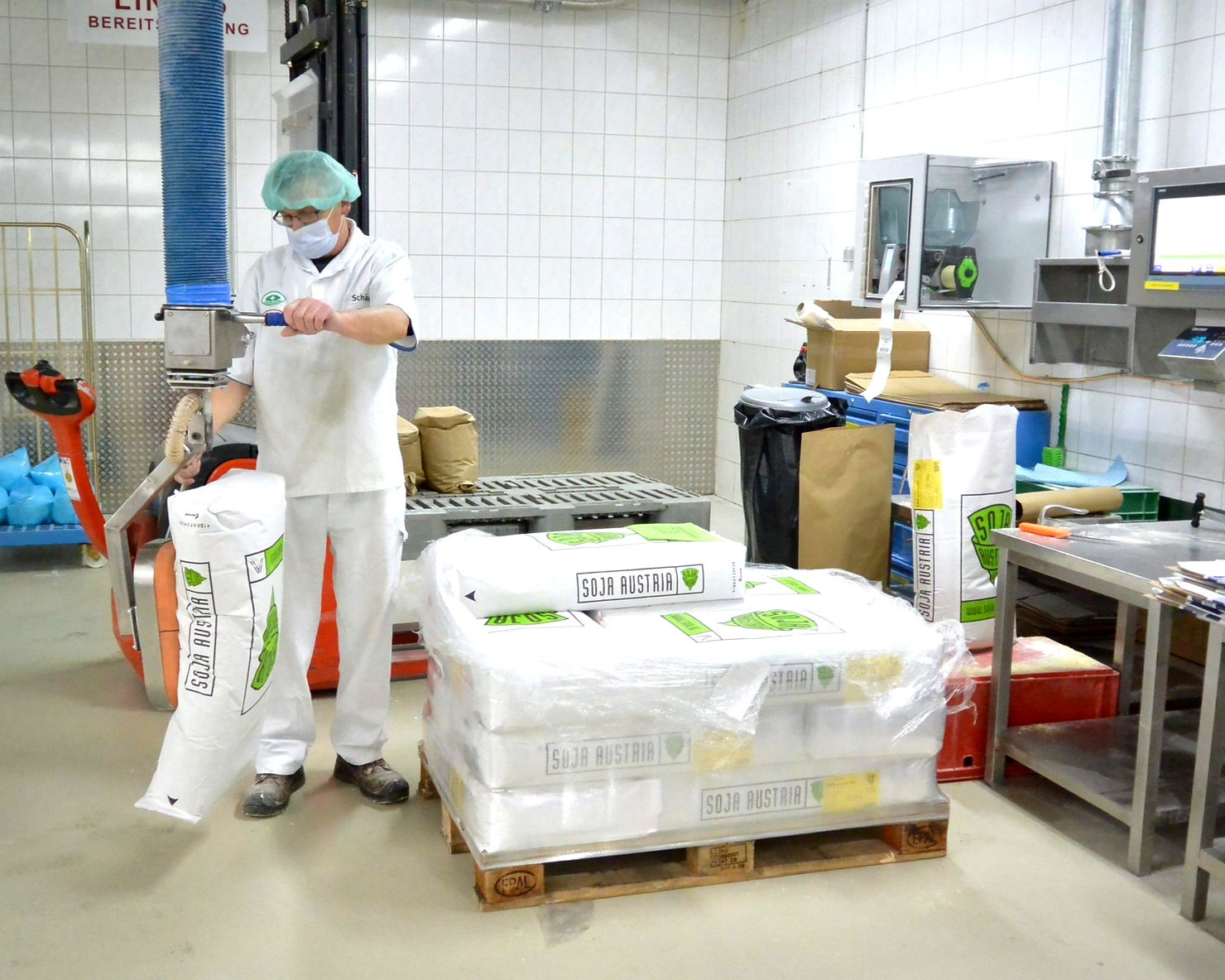
The task was a lifting aid for sacks in a large bakery—up to 35 kg, demanding lift and load work. Baking mix sacks had to be picked horizontally, rotated on the jib, set upright on a scale, opened, partly emptied, then lifted again to a pallet for interim storage.
Our solution combined ezzFAST vacuum lifter and ezzLINKeco wall slewing jib. An aluminium jib covers 400 cm radius to pick sacks and set them beside a scale. The sack gripper has a joint for horizontal pick-up and uprighting. For cartons, a quick-change coupling swaps suction cups quickly with minimal staffing.
Customer benefits:
Correct cup choice for sacks and cartons prevents drops; if the vacuum pump fails, the sack lowers slowly with the cup—extra safety and precision, less spillage and waste.
Intuitive ezzFAST operation allows high lift/lower speeds and throughput.
Staff avoid physical strain; moving and positioning sacks becomes easier.
Column crane systems can be stationary or mobile—valuable flexibility for seasonal peaks or different lines.
Stainless crane construction is easy to clean and meets hygiene standards.
Case study 2: lifting systems with pour function up to 300 kg in food production
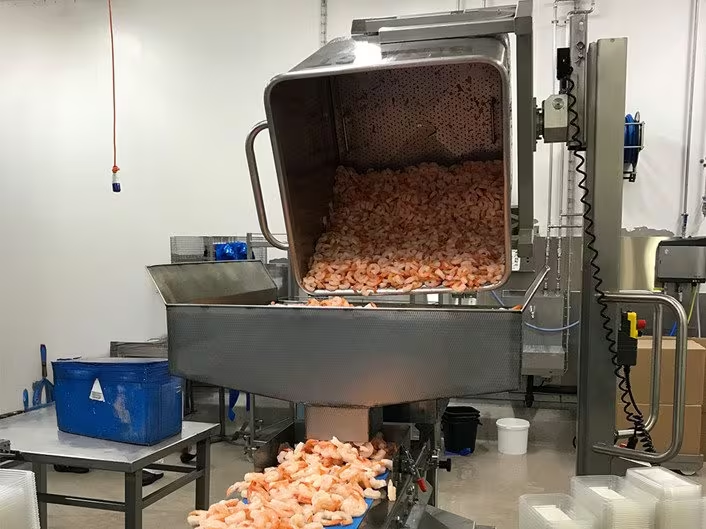
Large food quantities up to 300 kg had to be lifted into recipe batch trolleys and tipped onto a processing line.
For food use, mobile ezzLIFTmaster is fully stainless to meet hygiene standards. In the process, 250 kg of fish are emptied onto a line: the food container is raised over 2 m and electrically tilted into a chute. Remote control allows dosed emptying to avoid chute overflow—less waste and cost. Simple, safe batch trolley handling for operators.
Safety interlocks prevent accidental release. The custom lift system improves efficiency and productivity. During emptying ezzLIFTmaster stays at the chute and can be rotated by staff as needed—no lost time or fatigue. Four steerable castors make positioning easy across applications; compact design fits tighter areas. Musculoskeletal disorders, including back pain, cause about 30% of work absence; easy handling of loads up to 300 kg improves ergonomics and comfort.
Conclusion: configured handling technology for food
From your requirements specification, Best Handling Technology develops and implements a solution for your situation. Our solutions support safety aligned with ISO 14644 where applicable, efficient goods handling in production or warehouse logistics, relieved staff, and better effectiveness and ergonomics—contributing to business success.
Want to know more?
Our standards-compliant handling solutions give food producers the technology for productive, fast, ergonomic product handling. Questions or interest? Contact us at info@besthandlingtechnology.com.